Tuesday, 3 July 2012

Uganda 2012 Journal - Part 1

I have just returned from 2 weeks in Uganda leading a group of young people with Tearfund's Transform programme.  9 of us were hosted by The AIDS Intervention Programme (TAIP), one of Tearfund's partners who work to equip and mobilise local churches to respond to the effects of AIDS and HIV in Uganda.  They are based in Jinja, Uganda's second city, but work in many of the surrounding districts, as well as pioneering new work in the north.  We are a church youth group called YF (Youth Fellowship) from St Thomas' in Edinburgh where I am the Youth Worker.


This first post is me writing up the journal that I wrote in old fashioned pen-and-ink while out in Uganda. In blogging the entries, I have only added the occasional fact or extra piece of information - the feelings and experiences are very much as I tried to capture them when they occurred. The pictures which I will try to add as I go along were taken by the talented and wonderful Sarah Neville, a member of our team.  These are selected highlights only: the whole lot can be seen here: http://www.flickr.com/photos/82894987@N08/sets/


The team about to depart from Edinburgh
July 3 2012

I write this in my lovely room at the Victoria Panorama Hotel, Jinja.  For company I have a large flying bug of which I was rather scared at first (but which hasn't moved for a few hours from its perch on the ceiling light) and two little geckos, one of whom seems to live in the wardrobe!  They are less scary, but do tend to dart out unexpectedly and give me a fright!  At least they might eat the bugs :-)

Uganda is breathtaking.  The orange-ochre soil which greeted us on arrival at Entebbe Airport seems to flow up from the earth here - a rich, colorful metaphor for the life of the people here.  
On our way from Entebbe to Jinja we had a two-hour initiation into Ugandan life - crazy, busy but never seeming hurried or stressed.  Fred, our host from TAIP, is graciousness itself, arranging this stunning hotel overlooking Lake Victoria - Africa's largest lake, and the third largest freshwater lake in the world.

 Road workers in Jinja, with the wonderful orange Ugandan soil


Lake Victoria from our hotel, the Victoria Panorama in Jinja
Tonight the moon rose over the bay, illuminating the water's stillness with silver light - stunning.

Joseph, another of our hosts from TAIP, blessed of us with 5 large cases of bottled water - no purification tablets needed!  All the staff at the hotel are gracious and wonderful, from Daniel the porter/books 'harmoniser', to Elizabeth the owner.  Food has been tasty and filling - chicken stew, fried potatoes, rice and peas, pieces of fish, spinach and lots of Mountain Dew and Pepsi.  Delicious!

I am filled with love for the people here, and even more so for the team.  All have been patient and gracious - it must be the Ugandan spirit rubbing off on us!

God has been close.  Sweet sense of his grace on the plane as we set off.  Despite rushes to catch planes, lost bags and unfamiliar procedures, I have felt at peace.  Tonight we prayed - sang Everlasting God a capella with just clicked fingers and cicadas for percussive accompaniment in the balmy night.  Then a sweet, gentle Fatherly presence.  The YF prayed heartfelt thanks for all you have done LORD.  We are ready.

"Do not conform to the pattern of this world, but be transformed by the renewing of your mind."
Romans 12:1


Thursday, 29 March 2012

Hope - a fable.

"And now these three remain: faith, hope and love. But the greatest of these is love" 1 Corinthians 13

I'm imagining Hope as an actor, standing onstage giving a soliloquy.  It's a soliloquy about Love.  Love is the thing which Hope lives for, its very greatest desire.  Hope's words pour from its lips: sweet, fragrant, millifluous. 

Also on the stage is Faith, but Faith is invisible - a tangible presence, but one that cannot be discerned with the naked eye.  Some other faculty (perhaps Faith itself) is needed to perceive it.  So Faith is with Hope, but it is Hope who speaks, standing in the spotlight, speaking about the endless possibilities, the undying dance of Love.

As Hope speaks on, longing and wishing and praying for the delights of Love, two figures enter the stage.  They glide to the front of the stage, and gradually pass by the figure of Hope to stand naked in full view of those assembled in the semi-darkness.

The figures embrace.

And Hope smiles, bows ever so slightly, not to the audience, but to the unseen spectator.

It quietly leaves the stage to the lovers, departing unnoticed and unmissed.

Which is just as it should be.

Sunday, 25 March 2012

Recovering a Perspective of Nations

A long time away from the blog... but tonight  I felt compelled to get down some thoughts on a certain topic while it is fresh in my mind.

So much of my life journey concerns ME as an INDIVIDUAL.  It's as if ME and my individual, subjective experiences, beliefs and reactions to the world around me, are all I can see.  The problem is that they're like a fog that clouds my view of God and of his plans and purposes in the world.  But over the last few days, I've found myself influenced by a number of perspectives which express their ideas much more in terms of NATIONS, GENERATIONS, and MOVEMENTS - seismic shifts in the fabric of the human story, rather than tiny individualistic ripples in my own heart and mind.  Is this God speaking - the God whose perspective on the world, history and the future far overreaches even the greatest human minds, and the most perceptive cultural commentators?

Please allow me to list some of the ways I feel God might have been speaking, and share a few thoughts.

1) A Pastor's Prophecy for Scotland

The other night I was at a CLAN Gathering evening of celebration in the Wester Hailes area of Edinburgh.  CLAN is a nationwide movement of renewal and mission, centered on a summer conference which I've been a small part of for a few years.  In addition to a time of worship which was *off-the-chart* wonderful, Kenny Borthwick spoke eloquently and humbly about his dreams for CLAN and for Scotland.  My dear friend Malcolm believes he is a prophet for our nation.  As he spoke, and especially as I prepare to move away to England, I felt a real heart pang for the place of my birth - the country I've lived in all my life.  Kenny shared how God is maturing the charismatic movement in Scotland, and how CLAN needs to continue to seek to unite Christians around the Father's love, the salvation of the Son, and the power of the Holy Spirit - in order to reach the last, the least and the lost for the Kingdom.  It is a compelling vision - a vision of a nation transformed.

2) Worship and its nation-changing status
Thanks to a wonderful encouraging woman at church, I'm reading the worship leader Robin Mark's book Warrior Poets of the 21st Century. And a jolly enlightening read it is.  In once fascinating chapter, he totally reframes the worship debate from being about musical style or even missional strategy, and reminds us that, for Israel, worship was everything.  It was of crucial spiritual, political, economic and national importance.  Israel's whole national identity was built on the object of its worship - the One True God.  In the Old Testament, it is clear that worship could make or break a nation.  Put in extremely simple terms, when Israel worshipped Yahweh, they prospered in peace..  When they worshipped other things, they were hung out to dry.  While there is something a little simplistic about this analysis, there is something which resonates in me, and it is this: As people have a heart, so a nation has a heart, and so the world has a heart. This is why the great universal stories of Creation and Fall and Salvation still have something to offer us today as a nation, and as a worldview.  The basic human choice, whether as individuals or as society, is between God and idols.  We are all of us worshipping something.  What, ultimately, will we choose?  Robin's challenge, to me, is to stop underestimating the central importance of worship, and realise that it is at the heart of life, because it is all about the heart.  Captivate the hearts of our nation with Jesus, and we will win this nation for God.  Get the people's worship, you could say, and you'll get the the people.

3) Empire, Jamaica and Dreadlocked hopes

Recently Hannah and I both read James Robertson's outstanding book Joseph Knight, a novel about Scottish plantation owners' role in the slave trade between Africa and Jamaica.  I was reminded about this book by watching Jeremy Paxman's Empire series on BBC1.  Dislike for Paxman's style aside, it is a powerful programme, examining a nation's identity and heritage.  But to me it is the African Jamaicans' story
which is more captivating than that of their British overlords.  I also happen to listen to a lot of roots reggae and dub.  It is a music which articulates the identity of the black Jamaicans with a unique rhythm and a lyrical philosophy drawn from the story of the nation of Israel in the Old Testament.  For Rastafarians, the Western culture which had enslaved them is 'Babylon',a clear identification with the conquering empire of the biblical narrative.  And Africa, their almost mythical homeland, is the Promised Land - a place of freedom, authenticity and spiritual rootedness, much like the ideal Israel of the biblical narrative.

While I don't share the Rastas' love of soft drugs and overt reverence for certain political figures, I sure do admire their sense of identity.  It seems to me to be an identity which is national without being nationalistic, spiritual without being esoteric, and wonderfully creative in its timeless expression through reggae music.

I've been thinking a lot recently about the spirituality of popular music, and listening to George Harrison on the back of Scorcese's majestic documentary Living in the Material World, leads me to compare George's spirituality with my own, and that of the Rastas. George's seems essentially personal, while the Rastas' seems essentially communal.  Not to say there aren't elements of both in each, but there are noticeable differences too.  What implications would a more communally 'rooted' approach to identity, theology and creativity mean for the Christian scene?  We are called to be people of ALL tribes, and nations - not of NO tribe and nation.  What does genuinely communal spiritual experience (way beyond bland conformism and anxious control strategies) even look like? And what of the heavenly perspective of our worship?  Has the suffering of the Jamaican people led them to a deeper corporate identity, and thence to a greater hope in the deliverance of God?  And do we Christians have a sense of hope in a Promised Land we can feel and touch and taste with our spiritual senses in the here and now?


If can try to draw together some of these thoughts, I guess what I think all these influences are communicating is the idea of a broadened perspective.  The idea that God works in nations as well as individuals.  Yes, it begins in the individual heart, but each of our hearts are not as separate as we perhaps like to think.  Our Western illusion of autonomy and self-determination is always being overturned and undermined time after time, through relational and corporate factors as diverse as an economic downturn, a localised conflict or falling in love.

One of the great strengths of evangelicalism is its emphasis on individual conversion and subjective knowledge of God.  But its flipside is a tendency to buy into the Enlightenment myth that life is essentially every man for himself.  As we obsess over our indivudual righteousness and our consumer approach to Christian culture - have we lost something of the national, even international perspective which is such a driving force in the Bible?

We can talk about our individual lives.  We can talk about great cosmic forces, but in reality we often keep them conveniently at arms length.  What of the much harder 'middle path' - that of local church and town and nation?  It is this path that Jesus trod, when he walked the earth.  Jesus came to a particular nation, at a particular time in history and touched individual lives. But he also called a community of disciples into being.  He called them, and by extension, us, to create a new society for the Earth he was redeeming.  And He called it the Kingdom of God.

Friday, 13 January 2012

Morrissey vs JC Ryle: a Holy War?

“We have too often been content with zeal for orthodoxy, and have neglected the sober realities of practical daily godliness.”JC Ryle, Holiness

"I'd rather be famous than righteous or holy, any day, any day, any day."
Morrissey, The Smiths' Frankly Mr Shankly

Been taking a break from blogging (and from the internet in general over Christmas) but partly thanks to a new smartphone I have been thrust right back into my online universe!

My reading for this term's teaching for one of my groups is on the theme of Holiness.  So I decided to read what is apparently a bit of a classic, JC Ryle's book on that topic which he wrote in 1879 (!) It has been great reading it and drawing parallels and contrasts with Brian McLaren's Naked Spirituality which I'm almost finished.  (Both, though I'm reading critically, are rather wonderful.)

Anyway, there are a number of fascinating insights - not least the distinction and relationship between justification and sanctification. Another post perhaps. But the quote I began this post with jumped out as being a sympathetic voice to the post I tried to write a while back on orthodoxy.  It chimes with a number of things in me, in reference to the place of church in society:

1) While the church argues over dogma, people (Christians included) are going to hell in a handcart;
2)  an emphasis on experiencing spiritual practices as opposed to simply holding right beliefs is one of the most welcome movements of our time;
3) the radical idea that personal (and interpersonal) holiness and societal change (ie the Kingdom coming) are more closely linked than either our strategising or our piety usually suggest;
4)  and finally that I do really need to ask myself: do I WANT to be holy?

Morrissey has often struck me as a saint-in-waiting.  The honesty in the quote above is followed by the lines "But sometimes I feel more fulfilled, making Christmas cards with the mentally ill.  I want to live and I want to love - I want to catch something that I might be ashamed of!"


It's a confusing picture of a man looking for direction and fulfillment and feeling that fight within him.  Ultimately he plumps for relationship - "I want to live and I want to love" is surely one of the deepest cries of the human heart.  That he tries to shrug it off with the quip about STD's is typical of his attempt at sexy aloofness, but to me the deed is done - the heart is laid bare, and there's no going back.


And this is perhaps what true holiness is all about.  It's the finding of that fulfillment in the one relationship that can really bring it.  It's not about isolated acts of kindness, experimenting with altriusm as a philosophy.  It's about the Spring of Life which can only flow from a heart that knows Love and Life themselves to be not words or or disembodied forces, but a Person who is all these things and more than them.  It's living out the love that is within - a love which is not the all-too-often selfish love of human fallenness, but the perfect, all-conquering love of the Saviour of the World.

A prayer: Jesus make me holy, if for no other reason than because you are holy!

Monday, 19 December 2011

For All Who Truly Fight....

A heavy heart today, perhaps not a blogworthy sentiment.

Ach, it sucks, but I've been struggling with temptation.  Tiredness and self-pity provide gaps in the battlements of my soul through which the Evil One can shoot his arrows.   This year I first read about St Antony, the so-called Desert Father of the Christian faith.   I claim a real kindred spirit in St Antony, not because I presume to approach his holiness, but because I think I can feel coming against me some of the same attacks he faced in trying to stay faithful to Jesus Christ, and to his calling.  All sounds a bit melodramatic for a middle-class mama's boy in his suburban church, with his suburban life and suburban problems.  I don't care what anyone says - the spiritual battle is real.  It certainly feels real to me.  

I think that, me and God, we're winning the war.  But the battles are fierce. 

This from the Life of St Antony written in the 4th Century by Athanasius of Alexandria.    

But the devil, who hates and envies what is good, could not endure to see such a resolution in a youth, but endeavoured to carry out against him what he had been wont to effect against others. 

First of all he tried to lead him away from the discipline, whispering to him the remembrance of his wealth, care for his sister, claims of kindred, love of money, love of glory, the various pleasures of the table and the other relaxations of life, and at last the difficulty of virtue and the labour of it; he suggested also the infirmity of the body and the length of the time. In a word he raised in his mind a great dust of debate, wishing to debar him from his settled purpose. But when the enemy saw himself to be too weak for Antony's determination, and that he rather was conquered by the other's firmness, overthrown by his great faith and falling through his constant prayers, then at length putting his trust in the weapons which are 'in the navel of his belly' and boasting in them--for they are his first snare for the young--he attacked the young man, disturbing him by night and harassing him by day, so that even the onlookers saw the struggle which was going on between them. The one would suggest foul thoughts and the other counter them with prayers: the one fire him with lush the other, as one who seemed to blush, fortify his body with faith, prayers, and fasting. 

And the devil, unhappy wight, one night even took upon him the shape of a woman and imitated all her acts simply to beguile Antony. But he, his mind filled with Christ and the nobility inspired by Him, and considering the spirituality of the soul, quenched the coal of the other's deceit. Again the enemy suggested the ease of pleasure. But he like a man filled with rage and grief turned his thoughts to the threatened fire and the gnawing worm, and setting these in array against his adversary, passed through the temptation unscathed. All this was a source of shame to his foe. For he, deeming himself like God, was now mocked by a young man; and he who boasted himself against flesh and blood was being put to flight by a man in the flesh. For the Lord was working with Antony--the Lord who for our sake took flesh and gave the body victory over the devil, so that all who truly fight can say, ' not I but the grace of God which was with me.' 

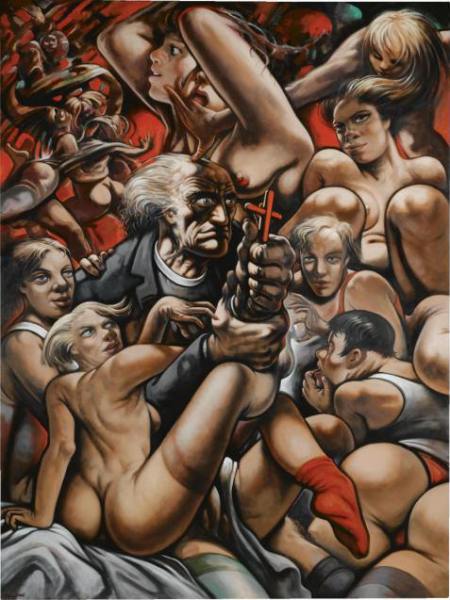
                                    The Temptation of St Antony by the Glasgow artist, Peter Howson

Monday, 12 December 2011

In the prayer room

This year we ran a prayer room in a local high school.  This is a poem I wrote while sitting in there one day:

In the prayer room I sit
And the air prickles with promise.
The wind that sometimes bustles
Along these corridors of knowledge
Can't dismantle the rooms and walls we've made
To try and tame the million multiverses
About which scientists still scratch their skulls
And theologians think threatened thoughts.
But my prayers - feeble as they are -
Like new-hatched birds blinking and shivering with still-membraned eyes -
Can yet penetrate the thickest walls
And the heaviest defenses
To peacefully storm the Keep of No Hope
with trembling faith.

Thursday, 1 December 2011

Pursuing the Pursued - Spiritual Hide-and-Seek and The Elusive Francis Thompson

Wow - it is much harder to find time to write now that I'm back at work, but I shall have a pop at it!  If this is a bit stream of consciousness, I apologise.

I'm sure I could expect a chorus of agreement when I begin by saying that some of the best things in life come along while you're on the loo.  In our smallest room, we have a selection of 'lavatory literature'.  Included are some childrens' books, anthologies and curiosities, a wonderful book called How to Read a Church which I bought on one of our travels in England, and a staggeringly hilarious book of geniune names from centuries past called Potty, Fartwell and Knob.  It's the most genuinely lavatorial book of the lot, as befits its lofty location.

We add and subtract to this loo library from time to time, and Hannah recently added a hitherto neglected favourite of ours: a BBC book called The Nation's Favourite Poems.  It might be populist, but golly, do jewels just pour from its pages!  (say that last sentence in a 'luvvie' voice, for maximum effect).

One evening, while, settling myself for a lengthly reign on the porcelain throne, I began to scan the index of the book, when one title caught my eye.  It was a poem called The Hound of Heaven by Francis Thompson.  I don't know about you, but when I come to read a poem, I long to find something that I can connect with - a word, phrase, sentiment which the author chooses that expresses something I too know, believe in, trust.   As the film Shadowlands put it: 'we read to know we're not alone'.  The spiritual promise of the word Heaven certainly drew me in... but perhaps also the roughness, the strength of the word Hound.   Anyway, I turned to it, and began to read.

Sometimes my spirit soars when I read a poem - and this is one of these.  Glory!  I love discovering a new creation.  I imagine it's something like a botanist feels on discovering a new species of plant, or a dinosaur hunter on discovering a whole new set of bones which suggest T Rex had feathers, or whatever!  The wonder!  But I think for me, the real joy in the slaking of the artistic thirst is in that sense that I am connected with another human being beyond my time, outwith my physical reach.  I want to leave art like that in the world.  I want people to listen or read or remember and feel "yes - here is someone who felt as I feel, and we share that now".  Is that a humble enough ambition?

Anyway, on to the poem.  I won't reproduce the whole text here. There is a link to the whole thing with explanatory notes here:

http://cummingsstudyguides.net/Guides3/hound.html

The poem tells of a man who runs from God, but God pursues him - the Hound of the title - although God is never referred to as Hound in the body of the poem itself.  It is starkly honest about our reasons for running from God.  For example, the fear that, should we choose God, we will lose what we already have:

For though I knew His love Who followèd,
..........Yet was I sore adread,
Lest having Him, I should have naught beside)

There are terrible admissions of the author's desire for God's followers to fail and somehow show God to be unworthy, all expressed in rich, deep paradoxes:

I tempted all His servitors but to find
My own betrayal in their constancy,
In faith to Him, their fickleness to me,
...Their traitorous trueness, and their loyal deceit.
 
The protagonist then goes on to seek satisfaction in other human beings, and then in Nature, but ultimately, neither is capable of quelling his longing, or putting off the One who pursues him:

those strong Feet that followed, followed after
..........But with unhurrying chase
..........And unperturbèd pace,
Deliberate speed, majestic instancy,

In vain he tries to shut it out, but:

That Voice is round me like a bursting sea 

In the end, he capitulates.  And man, the words God speaks to him are like sweet, glorious arrows in my breast:

All which I took from thee, I did but take,
.......Not for thy harms,
But just that thou might'st seek it in My arms.
.......All which thy child's mistake, 
Fancies as lost, I have stored for thee at home:..................................
.......Rise, clasp My hand, and come."
 
Those lines just DESTROYED me.

I hope you can see the majesty of this work, even from those brief quotations, which don't at all show the life-sweep of the poem in its full merit.  Go find that link and read the whole thing.  Do it now!  You won't regret it!

Thompson himself seems to me an elusive, almost mythical figure.  He was born in 1859 in Preston, Lancashire, trained in medicine, hated it, and promptly dropped out of society all together, living rough for a time on the streets of London.  He soon became an opium addict.  He sent some poems into a Catholic magazine (the implausably-titled Merry England) but having no fixed abode, Thompson gave as his address, that of the post office.  The editor, a Mr Wilfrid Meynell, was so impressed with the poems that he attempted to contact Thompson, but was unable to reach him.  The only way Meynell could get through to Thompson was by publishing his work!  Eventually an address was obtained of a certain local chemist, where Meynell discovered Thompson owed a large amount of money for opium.  Meynell squared the bill, and was pointed to a man selling matches in the street.  This man was Francis Thompson.

Meynell then took Thompson under his wing, arranging a stay at a monastery where he kicked his opium habit (althought his would be a lifelong struggle with addiction) and got to work writing and publishing poems.   It was during a stay in the Norbertine monastery of Storrington in 1889 that he wrote the Hound of Heaven.  The rest of Thompson's life seems to have been tough, if no longer materially, then certainly psychologically.  The details I could find online are sketchy, but he seems to have been an extremely sensitive, melancholic soul, prone to depression and periodic lapses into drug dependancy.  He died of tuberculosis on 13 November 1907.  He was 47.

Certain hints suggest that his struggles and failings were to some extent airbrushed out of his story by contemporaries.  One writer even claims that Meynell edited his poems to make them 'more Catholic'.  (Indeed, the version in the Nation's Favourite Poems is heavily abridged - I was surprised, although not a little delighted, to find an adittional 2 verses online!)

Books on Thompson seem fairly thin on the ground.  A recent scholarly monograph is, alas, way out of my price range.  So he remains a rather mysterious figure - and one that strikes me as having many of the hallmarks of contemporary tragic celebrity - middle-class upbringing, rebellious youth, near-destitution, drug addiction, 'discovery' by benevolent benefactor, spells in and out of the Priory, untimely death.  It's all rather rock 'n' roll, in perhaps the worst, and the yet most intriguing sense. 

In any case, the reality of his spiritual experience, as laid bare in the desperately beautiful Hound of Heaven, elevates him in my opinion, beyond a luridly tragic myth.

I know only too well the sobbing, petulant, ignoble, child in my own breast who tries to hide from God.  I ran and ran from God, but when I in desperation turned my head, he was right at my shoulder.  He'd been running after me all the time and I never knew it.

God, in his wisdom, allows us to play this game of hide-and-seek.  He patiently waits, like the good and patient Father he is, counting to one hundred, as we rush to fussily conceal ourselves, our true selves.  Thompson reminds us that we do our hiding in all kinds of places.   And not the least of these hiding places is our own mind.

Submission to God is a strange thing.  When we submit to God, it is a moment when we are both at our most humiliated and our most dignified.  It's our moment on our own cross of Calvary.  It is when we cry out, as Jesus did: "My God My God Why have you forsaken me".   It is at that moment of terrible emptiness that God rushes in like a torrent of passion and fills us to overflowing.

Somehow, we have to go through it - the grief, the loss, the tears of rage, the desperate pumelling of our puny fists on the opressive ceiling of our human understanding; but when, exhausted, we finally surrender to the Patient Pursuer of Peace, when we finally cry out: 'I am caught, I am caught!',  then God reveals just enough to make us collapse in loving gratitude. 

All which I took from thee, I did but take,
.......Not for thy harms,
But just that thou might'st seek it in My arms.

Are you on the run from God?  How long will you run, before you turn and run into His arms?